Share this

Research on periodic small perturbation suppression in servo systems

2026-04-06 07:36:57 · · #1
Abstract: This paper proposes a nonlinear controller for a fourth-order field-oriented control model of an asynchronous motor in the d-q coordinate system. Using a state feedback control design method, a nonlinear controller capable of suppressing periodic disturbances is designed. Experimental and simulation results show that the controller has high performance. Keywords: servo system; nonlinear controller; state feedback; disturbance attenuation. 0 Introduction Improving the steady-state accuracy, dynamic response characteristics , and anti-interference capability of servo systems has always been a hot topic in CNC technology research. While the classic P or PI control methods are simple and easy to implement, they suffer from limitations in the linearization approximation process of the model. Inevitably, the inherent information of the system is lost. Under the requirements of high-speed motion, high positioning, and high tracking accuracy of CNC machine tools, the shortcomings of traditional control methods, such as poor adaptability to control parameters and weak anti-interference ability, have become apparent. This paper utilizes nonlinear state feedback control theory to design a feedback controller for the system under periodic disturbances. Experiments and simulations were conducted in the motion control of a machine tool feed servo system driven by an asynchronous motor, achieving good control results. 1. Description Model of Asynchronous Motor The characteristics of the asynchronous motor can be described by a fourth-order model in the dq coordinate system under field-oriented control. The model from the literature is cited here. The relevant symbols are defined as follows: Rs—Stator resistance of the asynchronous motor; Rr—Rotor resistance; Ls—Stator inductance of the motor; Lr—Rotor inductance of the motor; M—Mutual inductance of the motor; u—Input voltage; i—Current; φ—Magnetic flux; TL—Load torque; J—Motion of inertia; K—Equivalent friction coefficient; np—Motor logarithm; ω—Motor speed. Therefore, the state equation of the asynchronous motor can be described as: 2. Design of Nonlinear State Feedback Controller If we introduce an inner loop controller, the current in each phase of the motor during operation can be detected by sensors. The values ​​of i[sub]φ[/sub] and i[sub]d[/sub] can be calculated through z/3 transformation. The magnetic flux φ[sub]d[/sub] can be obtained by the flux observer algorithm. When we appropriately control the range of values ​​of i[sub]d[/sub] and φ[sub]d[/sub], we can obtain a fourth-order positive definite matrix P. 3 Experiment and Simulation The experimental system is shown in Figure 1. The slide table is fixed on the vibration table. A multi-purpose speed and torque sensor is installed on the load of the slide table. The sensor signal is amplified by a charge amplifier, and the encoder signal is introduced into the computer through the interface card. The computer processes the signal and sends the control signal. The experimental process is as follows: First, the motor is started to reach a stable operating state with a speed lower than 5% of the rated speed. This state is maintained, and then the vibration table is started. Since vibration can be equivalently converted into a certain amount of load torque input and can be detected by the sensor, we can consider it as a periodic disturbance input. The PI controller always follows the change of this disturbance and always fluctuates within the range of 0.3 to 0.5 of the ideal speed. When using a nonlinear controller, except for a large fluctuation (around 0.5) at the moment of sudden disturbance, the fluctuation is less than 0.001 at other times. The experimental data is the average of 5 times. When the motor runs at high speed, the changes of i and i are relatively rapid, so the computer cannot control it online and can only simulate it. References : [1] Feng Yong. Modern Computer Numerical Control System [M] Beijing: China Machine Press. 1996. [2] Tuan HD, Hosoe S. On linear robust controllers for a class of nonlinear singular perturbed systems [J]. Automata. 1999, 35: 753-739 [3] Feng G, Cao SG. Rees NW An approach to control of a class of nonlinear systems [J]. Automatica, 1996. 32 Author Introduction : Li Xi, Tang Xiaoqi, Zhou Yunfei, Chen Jihong National Engineering Research Center for Drum Control System
Read next

CATDOLL Yuki Hard Silicone Head

The head made from hard silicone does not have a usable oral cavity. You can choose the skin tone, eye color, and wig, ...

Articles 2026-02-22

CATDOLL 140CM Qing TPE

CATDOLL 140CM Qing TPE

Articles
2026-02-22
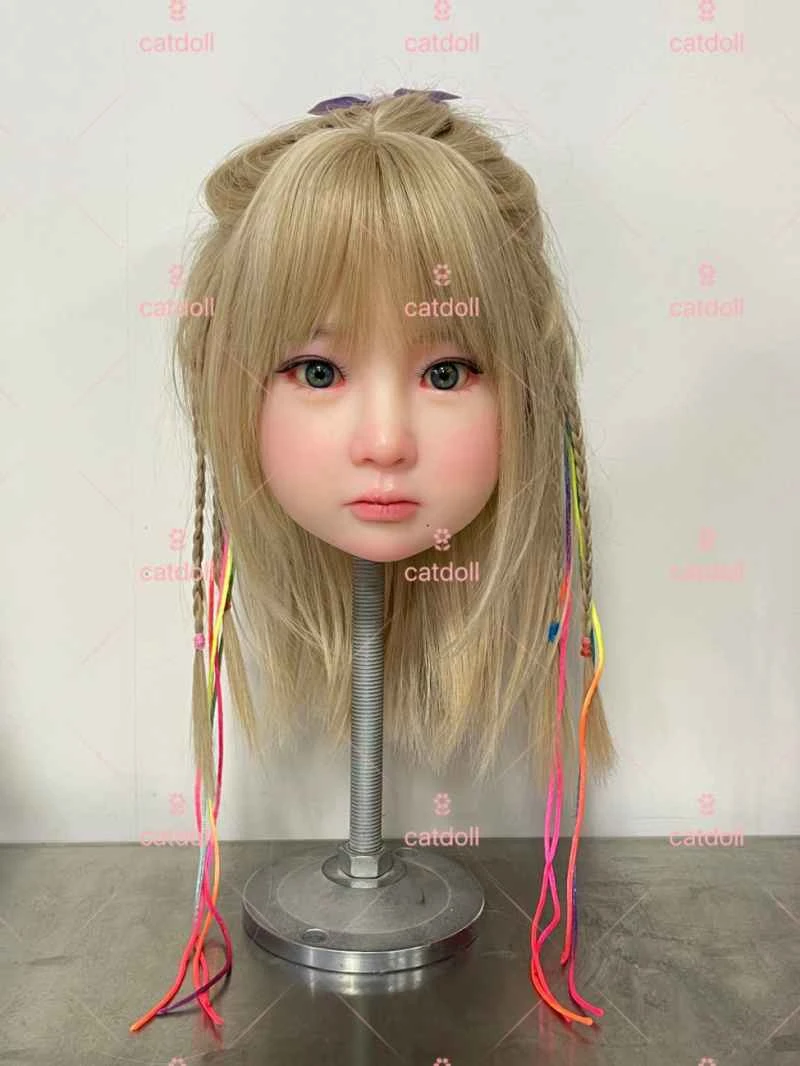
CATDOLL Dudu Soft Silicone Head

CATDOLL Dudu Soft Silicone Head

Articles
2026-02-22

CATDOLL Kara Hard Silicone Head

CATDOLL Kara Hard Silicone Head

Articles
2026-02-22