Share this

FPGA-based stepper motor controller design

2026-04-06 06:21:37 · · #1
A stepper motor is a special type of motor that converts electrical pulse signals into corresponding angular displacement. Each change in energization causes the stepper motor rotor to rotate one step. Currently, most stepper motor controllers require a main controller to send a clock signal and at least one I/O port to assist in controlling and monitoring the stepper motor's operation. In microcontroller or DSP applications, they are often used in conjunction with CPLDs or FPGAs to implement specific functions. This article introduces a stepper motor controller implemented using an FPGA. This controller can act as a direct digital control peripheral for a microcontroller or DSP; simply writing data to the controller's control register and frequency divider register is sufficient to control the stepper motor. 1. Stepper Motor Control Principle Stepper motors are digitally controlled motors that convert pulse signals into angular displacement. That is, given a pulse signal, the stepper motor rotates by one angle, making it very suitable for controlling digital systems. Stepper motors can be divided into reactive stepper motors (VR), permanent magnet stepper motors (PM), and hybrid stepper motors (HB). The most significant difference between stepper motors and other control motors is that they are controlled by input pulse signals. The total rotation angle of the motor is determined by the number of input pulses, while the motor speed is determined by the pulse signal frequency. The stepper motor's drive circuit operates based on control signals, which are generated by various controllers. Its basic principles are as follows: ① Controlling the commutation sequence: This process is called "pulse distribution." For example, in the single four-phase stepper motor's single four-step operation, the energizing sequence of each phase is ABCD. The energizing control pulses must strictly follow this sequence to control the on/off state of phases A, B, C, and D, thus controlling the stepper motor's direction of rotation. If the energizing sequence is correct, the stepper motor rotates forward; if the sequence is reversed, the motor rotates in reverse. ② Controlling the stepper motor's speed: Sending a control pulse to the stepper motor causes it to rotate one step; sending another pulse causes it to rotate another step. The shorter the interval between two pulses, the faster the stepper motor rotates. Adjusting the pulse frequency issued by the controller allows for speed control of the stepper motor. 2. Overall Design of the Controller The external interface circuit of the controller is shown in Figure 1. The functions of each pin are as follows: The internal block diagram of the controller is shown in Figure 2, consisting of a command word register (Cmd_reg), a frequency division coefficient backup register (fdiv_back), a frequency divider, and a phase output state machine. The command word register Cmd_reg is composed as follows (the corresponding address is "00"): X Unused bit. Ini is valid when the controller is initialized to 1. When this bit is 1, the data in the backup register is directly loaded into the frequency divider register reg_dATA[15~0], and is automatically set to 0 by the hardware after loading. Newr is set to 1 when a new frequency division coefficient is written to the running controller; when the clkout clock output of the next frequency divider arrives, fdiv_back is written into reg_data[15~0], and the frequency divider divides the frequency according to the new frequency division coefficient. Manner[1~0] is the motor drive mode, used to control the output of the phase output state machine. "00" indicates a single four-phase mode, with four-phase output as (ABCD); "Ol" indicates a double four-phase mode, with four-phase output as (ABBC-CD-DA), and eight-phase mode as (A-AB-B-BC-C-CD-DDA). The frequency division coefficient backup register (fdiv_back) is a two-byte register. reg_data[15~0] is a 16-bit register of the frequency divider, receiving the value of fdiv_back, and dividing the system frequency by 2~65536. For a 12MHz input frequency, the frequency after division is 6MHz~183Hz. (In this design, the starting speed, torque, and acceleration of the stepper motor are calculated by the user according to the actual situation.) After frequency division, each clkout moves one step angle. For a motor with a step angle of 1.8°, it can meet the requirements of various speeds. 3. Frequency Divider Design The frequency divider is the key to the implementation of this controller. Here, it is treated as an independent module. dATA[15~0] is the frequency division coefficient. The system clock Clk is divided by the median of the divider register, and the output Clkout serves as the clock for the phase output state machine. Each Clkout arrival triggers a phase transition, causing the stepper motor to move one step angle. The divider program is as follows: Figure 3 shows the simulation diagram of the single four-step output with a 3-fold divider. Conclusion The innovation of this paper is that the control word and divider coefficients of the stepper motor controller are mapped to the memory space of the main controller (DSP or microcontroller, etc.). Control only requires write operations, simplifying and facilitating stepper motor control. Furthermore, it saves peripheral resources of the main controller (DSP or microcontroller, etc.) and reduces the load on the board. A total step count control register and its circuit, an acceleration register and its control circuit, etc., can be added to the system to create a more intelligent stepper motor controller.
Read next

CATDOLL CATDOLL 115CM Shota Doll Kiki Male Doll

Height: 115cm Male Weight: 19.5kg Shoulder Width: 29cm Bust/Waist/Hip: 57/53/64cm Oral Depth: 3-5cm Vaginal Depth: N/A ...

Articles 2026-02-22
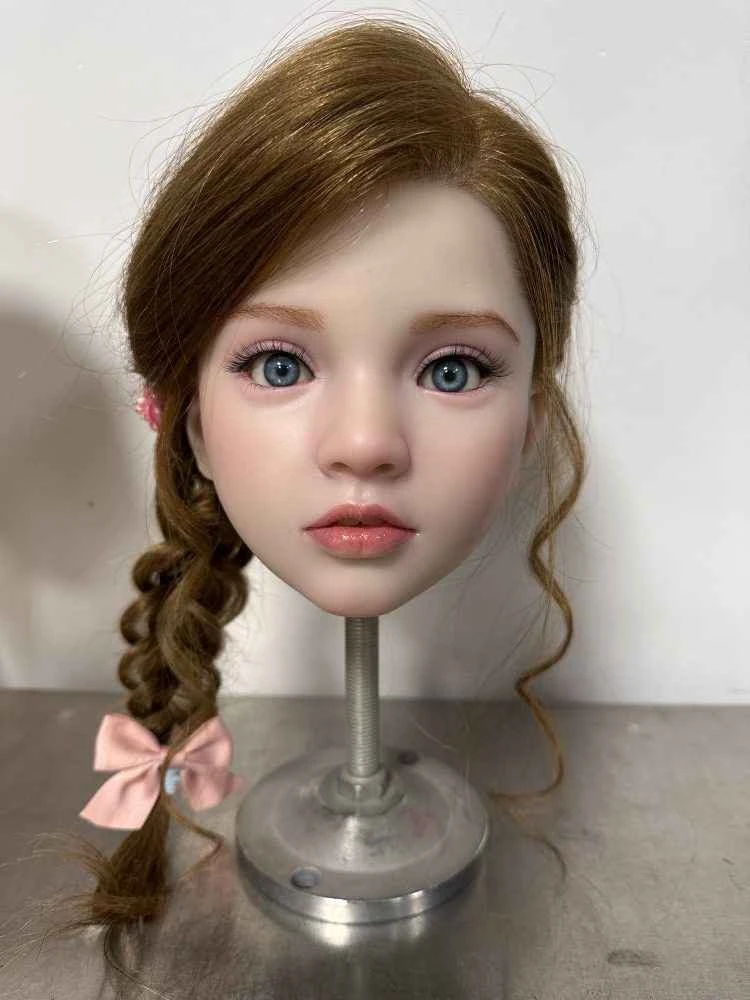
CATDOLL Milana Hard Silicone Head

CATDOLL Milana Hard Silicone Head

Articles
2026-02-22

CATDOLL 128CM Diana Silicone Doll

CATDOLL 128CM Diana Silicone Doll

Articles
2026-02-22
CATDOLL 166CM Jo TPE

CATDOLL 166CM Jo TPE

Articles
2026-02-22